

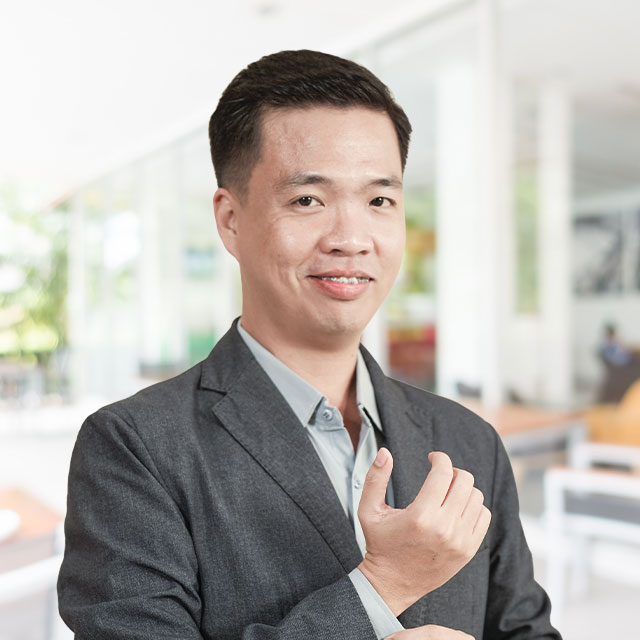
With the motto “No pain, no gain,” Minh views his MBA Talent journey not simply as knowledge acquisition, but as a rigorous “trial by fire.” It was precisely these pressures that forged a resilient leader, ready for the next career levels.
Before MBA Talent, what was the biggest “bottleneck” in your career that troubled you?
My biggest issue at the time was “I didn’t know what I didn’t know.”
I’d always set my sights on becoming a COO (Chief Operating Officer). However, observing those who came before me, I saw some exceptional leaders – their ability to motivate and guide teams was extremely effective – but there were also those who couldn’t quite achieve that.
I asked myself: In that position, what qualities and skills do I need to succeed? I needed an answer to the question of management capability at the senior leadership level.
I realized I lacked a solid foundational knowledge system. My decision to study stemmed from the belief that this program would give me the right “hints” and direction to explore and fill those capability gaps myself.
What motivated you to embark on the MBA Talent journey?
The turning point came when I heard from Ngo Cong Truong – Founder of John&Partners – a Western Sydney alumnus. He convinced me through his own real experience: how the program systematizes academic knowledge for direct business application. It builds an extremely solid foundation for personal development.
But a deeper motivation came from two emotional factors. First is the joy of development – I follow the “lifelong learning” philosophy. I’m happy when I see today’s version of myself better than yesterday’s, and tomorrow will be better than today. Second, I want to tell my children when I’m older: “Back then, Dad faced these difficulties, and this is how Dad worked to overcome them.” That’s the strongest spiritual motivation to keep me from giving up.
If you compare this program to a “forge”, when did you feel you’d hit rock bottom in terms of limits and pressure?
Those 18 months were a sine wave with many ups and downs. But the first 2-3 months were truly shocking.
Entering courses like Financial Reports for Decision Making or Integrated Business Experience (IBE), I felt I’d hit the “bottom” of the challenge, massive workloads hitting all at once, combined with difficult problems I’d never encountered before.
The peak was Professor Michael Saram’s IBE course. The knowledge volume was massive, running parallel to simulation games and group assignments. Staying up until 1-2 AM was normal; one night, my group members and I worked until 4:30 AM. The pressure was so intense that despite giving 200%, we felt we’d only completed 70% of the professor’s requirements. The oral exams with unpredictable questions were truly “unforgettable” experiences I’d never encountered, even in university entrance exams.
Amidst those sleepless nights and “unprecedented” pressure, what kept you from quitting?
There were moments of exhaustion where I asked myself: “For what? Why am I trying so hard?” But two factors kept me going. First was my teammates. I was fortunate to have wonderful group members. Though younger, they were brilliant, very business-minded, and always encouraging each other. That bond pulled me up when I wanted to collapse.
Second was thinking about my “future version.” When I wanted to give up and return to a comfortable daily life, I’d ask myself: “In 10 years looking back, do I want to see someone who gave their all with no regrets, or someone who quit halfway?” I wanted to thank today’s version of myself for persevering. And truly, the pride of passing that course was priceless. If IBE couldn’t “knock me down,” it only made me stronger.
After “emerging from the cocoon” through that transformation process, how do you see yourself changed in thinking and capability?
I often compare this process to a caterpillar becoming a butterfly. There must be pain for there to be results. MBA Talent powerfully impacted both my thinking and management toolkit.
In thinking, I became more tenacious, more resilient. The biggest shift was my attitude toward difficulties. In the past I might have been anxious, but now I face storms much more calmly and peacefully. I know my path much more clearly compared to the ambiguity of two years ago.
In tools, I was particularly impressed with finance and strategy. For example, thanks to Professor Duc Vo, I understand you can’t assess a company’s health through just one year or one metric. You must look at the overall picture connecting the Balance Sheet, Income Statement, and Cash Flow over time. These are sharp tools for a manager.
Translating that change into your career, how do you assess your readiness for the COO position you aspire to?
If I self-assess my readiness for COO on a scale, before studying, I was only confident around 3 points. But currently, I’m confident at 7-8 points.
Interestingly, the job market is also responding to this change. Recently, I’ve received many LinkedIn invitations for positions very close to COO expectations. Especially at my current company, leadership has already mentioned a promotion path to Director of Operations, exactly matching my initial goal. I believe that’s not a coincidence, but the result of accumulated capability and leadership presence.
Your message to future students?
I’ll borrow Steve Jobs’ famous quote: “Stay hungry, stay foolish.” Always be hungry, be foolish enough to embrace the new. Maintain your hunger to learn new things to develop yourself better each day.
This journey will have moments when you feel lonely, making difficult leadership decisions, but that’s the price worth paying for growth. Prepare yourself mentally to “shed your skin” and embrace a better version of yourself.
Thanks for your valuable and sincere sharing. We wish you continued success and solid progress on your career path ahead!
MBA Talent is a comprehensive training program designed to cultivate talented C-level executives. The program combines the strong academic foundation of Western Sydney University and the ISB Institute, with real-world business cases developed by the PSO Institute, empowers students to skillfully apply modern leadership knowledge to complex business scenarios.
MBA Talent
